
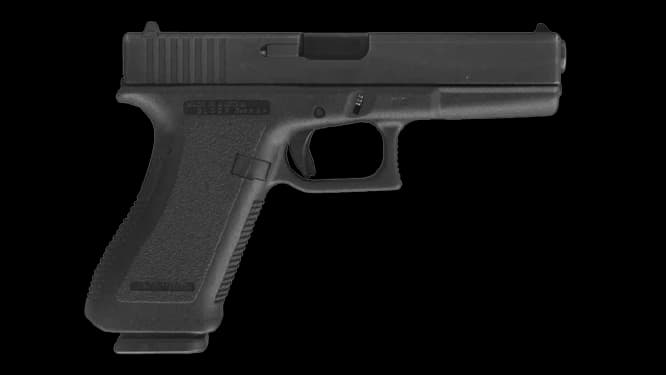
The pistol that changed everything.
In 1980, the Austrian Army announced a competition to replace their aging Walther P38 service pistol. Engineering firms across Europe submitted refined, all-metal designs. Then a curtain-rod manufacturer named Gaston Glock — who had never designed a firearm — entered with a pistol made mostly of plastic.
Critics laughed. The Austrian military didn't. Two years and 25,000 stress-test rounds later, the Glock 17 won the contract by a margin so embarrassing to its competitors that the trials were quietly buried.
Today, more than 65% of all U.S. police departments issue a Glock as their standard sidearm. The Austrian Bundesheer carries it. So do the British SAS, the Norwegian Armed Forces, the Indian Special Frontier Force, and tens of thousands of officers across Europe and Asia. No handgun in history has spread further, faster, or against more skepticism.
“Critics said a plastic pistol would melt in a fire, crack in the cold, or bend out of spec. Forty years and 20 million units later, none of that has happened.”
Massad Ayoob, Firearms Instructor
Why it works.
The Glock 17 is built on a single radical idea: simplicity is reliability. The entire pistol — every working mechanism — uses just 34 parts. A Beretta 92 has 70. A SIG P226 has 53. Each part Glock removed was one less thing that could break, freeze, foul, or fail.
The polymer frame doesn't rust, doesn't warp, weighs 30% less than equivalent steel, and absorbs recoil energy in a way metal frames physically can't. The "Safe Action" trigger replaced manual safeties with three internal automatic ones. There is no decocker, no slide-mounted safety, no magazine disconnect. You draw it. You pull the trigger. It fires.
What it feels like to shoot.
The first thing first-time shooters notice is the recoil — or rather, the absence of it. The polymer frame flexes microscopically with each shot, soaking up energy that would otherwise punch back into your hand. Follow-up shots are faster. Groups are tighter. Confidence builds in seconds.
The trigger feel is what made Glock famous: a deliberate take-up, a clean break at around 5.5 lbs, and a short reset that lets you stay on target. It's not a competition trigger — but it's been the benchmark every other striker-fired pistol has been measured against since 1982.
If you've never fired a handgun before, the Glock 17 is the one we recommend you start with. If you've fired hundreds, you'll appreciate why this one became the standard.